

Bhotekoshi flood hobbles hydropower sector
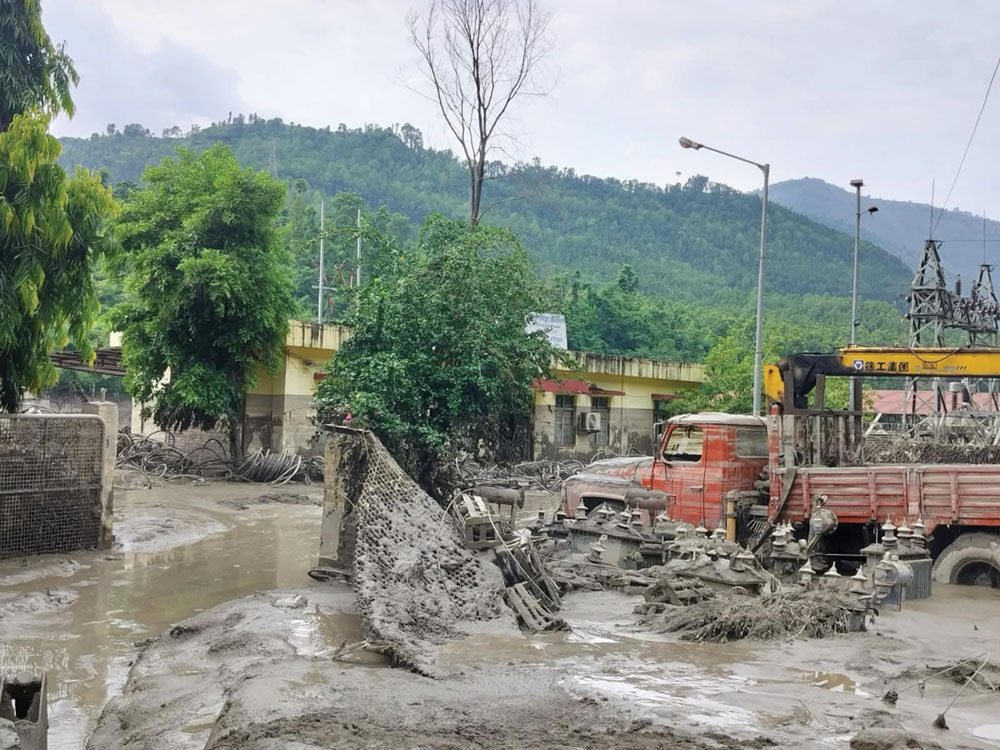
SATV, Kathmandu, Aug. 31: The devastating flash flood in the Bhotekoshi River has dealt a major setback to Nepal’s hydropower sector, damaging over a dozen hydropower projects and associated transmission infrastructure in Rasuwa and neighbouring districts.
Preliminary assessments show that at least 13 hydropower projects, both operational and under construction, have suffered damage, with the affected projects representing hundreds of megawatts of generation capacity. The destruction has also raised concerns over prolonged disruptions to electricity generation and the cost and time required for reconstruction
The floods triggered by the Bhotekoshi River on August 26 caused extensive damage to hydropower projects, transmission infrastructure, substations and other electricity facilities in the district.
Several major hydropower projects, including 216 MW Upper Trishuli-1, 111 MW Rasuwagadhi, 120 MW Rasuwa Bhotekoshi, 78 MW Sanjen Khola, 6.42 MW Upper Mailung A, 5 MW Mailung Khola, 20 MW Langtang Khola and 22 MW Chilime hydropower projects, have been affected by the floods.
Similarly, in Nuwakot, four operational projects with a combined capacity of 123 MW and two under-construction projects totalling 52.6 MW have been affected.
The projects include the 24 MW Trishuli Hydropower Project, 14.1 MW Devighat Hydropower Project, 60 MW Upper Trishuli-3A, 37 MW Upper Trishuli-3B, 15.6 MW Middle Trishuli Ganga and the 25 MW Sotar Hydropower Project, have been affected by the flood.
The impact has extended beyond generation facilities to the transmission network. The Trishuli 220 kV 3B Hub Substation has been completely damaged, while several transmission lines and towers operating at 132 kV, 66 kV and 220 kV have also sustained damage. The disaster has also disrupted the operation and construction of hydropower projects and raised concerns over the safety of workers.
Hundreds of workers feared trapped
Hundreds of people associated with hydropower projects in Rasuwa and Nuwakot have remained unaccounted for, while rescue operations are continuing at project sites, including tunnels where workers are believed to be trapped.
According to Acting Managing Director of the Nepal Electricity Authority (NEA) Dirghayu Kumar Shrestha, the hydropower sector has suffered unprecedented physical losses from the Bhotekoshi floods.
“This is a huge loss, both in terms of physical infrastructure and human lives. Practically, the hydropower sector has never suffered such extensive physical damage, although many hydropower projects have been damaged by floods every year,” Shrestha told The Rising Nepal.
He said the losses in the hydropower sector would create challenges for the country not only in managing power supply but also in attracting and protecting investment, as huge amounts of public money invested through banks and financial institutions, as well as individual investments, had been lost. Even if insurance covers the losses incurred by hydropower projects, the state’s investment has ultimately been lost, he said.
President of Independent Power Producers' Association, Nepal (IPPAN) Mohan Kumar Dangi said that the unexpected flash floods in Bhotekoshi River has added challenges for advancing hydropower projects in coming days. "We should not panic in advancing projects looking at the present damage caused by flood. But it taught us to advance project studying catchment area of the project to be constructed as well," he said.
A major blow to the power sector
The loss of 431 MW is significant for Nepal’s electricity system as it represents roughly 10 per cent of the country’s installed generation capacity, 4,300 MW. The immediate concern, however, is not simply the loss of generation capacity but the combined impact on power generation and the transmission network.
The shutdown of multiple hydropower plants has reduced available domestic generation, while damage to substations, transmission lines and towers could prevent electricity from being supplied even when generation is available elsewhere. “This creates a more complex challenge for the NEA than the temporary loss of individual power plants,” said Shrestha.
The damage to projects under construction is also likely to have longer-term implications, he said. “It is not simply that 10 per cent of the total installed generation capacity has been lost. Projects with a combined capacity of 500–600 MW that are under construction have also been damaged. This will definitely affect our ability to manage power supply in the coming days,” he said.
He said there was currently no problem with power supply across the country, despite the complete shutdown of projects generating around 430 MW. “There will be no difficulty in managing power supply throughout the rainy season as other projects are operating at full capacity. However, there will certainly be challenges in managing power supply during the dry season, as the production of other hydropower projects will decline significantly,” MD Shrestha said.
According to him, the NEA will plan to install solar plants and explore other possible measures to ensure a reliable power supply across the country during the dry season as well.
Detailed damage assessment after rescue operations
Preliminary assessments indicate that the damage could run into billions of rupees. The government will conduct a detailed assessment of the physical damage caused to hydropower projects after completing ongoing rescue and rehabilitation efforts, said NEA MD Shrestha.
He said it was too early to determine the extent of damage to the hydropower projects or how many of the affected facilities could be brought back into operation, as rescue operations were still underway.
Several hundred people are believed to be trapped inside tunnels and other affected areas, making rescue the immediate priority, he said.
“Rescue efforts for people believed to be trapped inside the tunnels have been intensified with the mobilisation of both domestic and international teams,” Shrestha said.
He said a comprehensive technical assessment would be carried out after the rescue and rehabilitation works to determine the extent of damage to generation and transmission infrastructure.
The assessment will also be necessary to estimate the cost of restoring the damaged infrastructure and determine how quickly the affected hydropower projects and transmission facilities can be brought back into operation, he said.
IPPAN President Dangi said that, given the extent of the flooding and the damage it has caused, the hydropower sector could face losses worth tens of billions of rupees.
However, the actual extent of the loss can only be determined after completing detailed assessments of individual hydropower projects and electrical infrastructure.
About the author
System Admin
This author has not added a bio yet.
Comments (0)
Be the first to comment!
Leave a Reply
Your comment will be reviewed by an admin before being published.